
Hubble SOMA Survey Reveals Massive Star Formation Mechanics
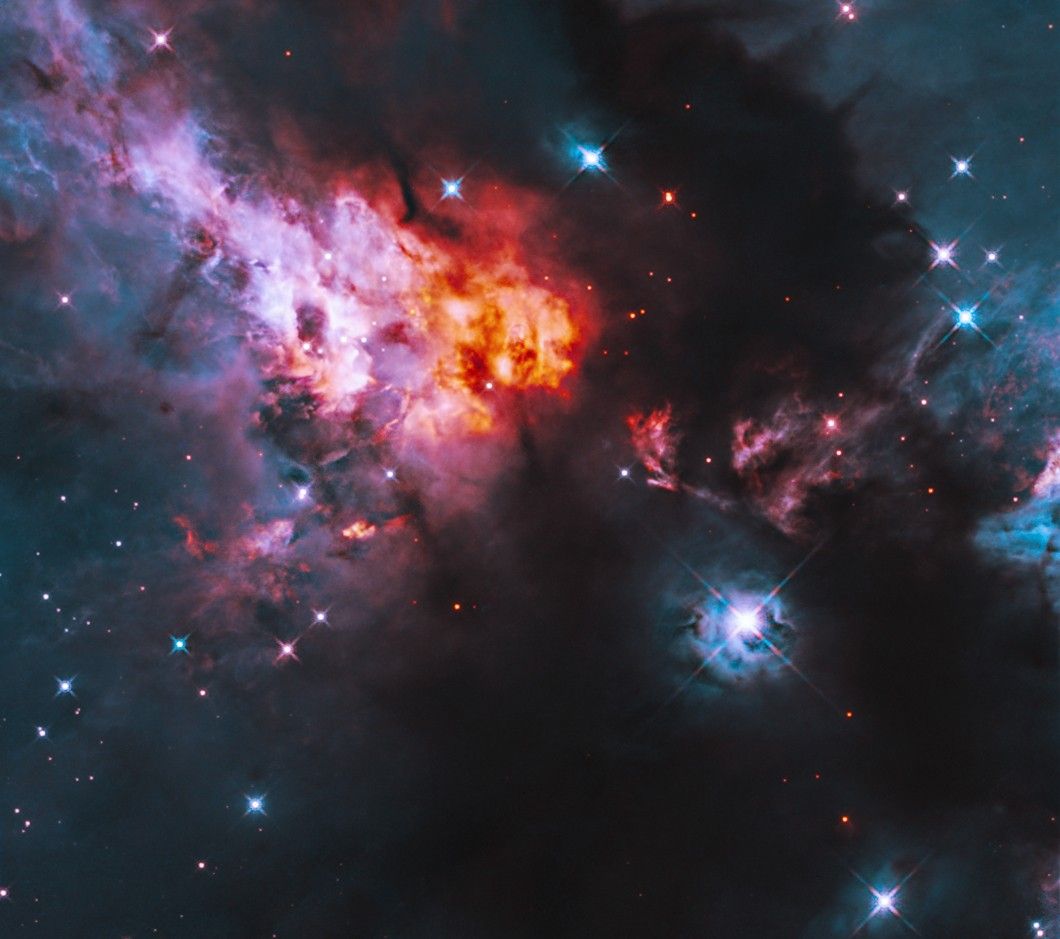
The Cepheus A region is home to a number of infant stars, including a protostar that is responsible for much of the region’s illumination.
NASA, ESA, and R. Fedriani (Instituto de Astrofisica de Andalucia); Processing: Gladys Kober (NASA/Catholic University of America)
GREENBELT, Md. — New high-resolution imaging data released by NASA and the European Space Agency (ESA) on January 21, 2026, provides astronomers with a detailed view of the earliest stages of high-mass stellar evolution. The images, captured by the Hubble Space Telescope’s Wide Field Camera 3 (WFC3), target four distinct protostars shrouded in dense molecular clouds, offering critical insights into the formation of stars exceeding eight times the mass of the Sun.
The observations were conducted as part of the SOFIA Massive (SOMA) Star Formation Survey. This multi-observatory campaign integrates Hubble’s near-infrared capabilities with data from the now-retired Stratospheric Observatory for Infrared Astronomy (SOFIA) to test prevailing theories regarding how massive stars accumulate mass without dispersing their accretion disks.
Piercing the Veil of the Molecular Cloud
The formation of massive stars remains a significant astrophysical question. Unlike low-mass stars like the Sun, which form over millions of years, massive B-type and O-type stars ignite and evolve on timescales as short as 100,000 years. This rapid accretion generates intense radiation pressure that, according to classical models, should halt the inflow of gas and dust required for the star to grow.
To understand how these stars overcome this barrier, researchers utilized Hubble’s near-infrared sensors to peer through the opaque dust surrounding the protostars. The new imagery reveals "outflow cavities"—structures carved into the stellar nursery by powerful jets of gas ejected from the poles of the developing stars.
According to the NASA mission team, while the protostars remain shrouded in dust that blocks visible light, Hubble’s near-infrared detection capabilities allow astronomers to see the emission shining through voids created by the jets. This radiating energy provides data on the structure and dust content of the cavities.
Targets of the SOMA Survey
The newly released dataset focuses on four specific regions of active star formation, each demonstrating different aspects of protostellar development.
Cepheus A
Located approximately 2,400 light-years from Earth in the constellation Cepheus, this region hosts a cluster of nascent stars. The primary target, a massive protostar designated HW2, is responsible for illuminating the surrounding gas. The Hubble imagery details a nebular region where intense ultraviolet radiation has ionized the surrounding hydrogen gas, creating an HII region. Light from the hidden protostar escapes through the cavities created by its polar jets, scattering off the dust to reveal the turbulent environment within.
IRAS 20126+4104
Situated 5,300 light-years away in the constellation Cygnus, this target features a massive B-type protostar. This class of star is characterized by extreme surface temperatures and high luminosity. The Hubble observations resolve a bright region of ionized hydrogen energized by jets emerging from the protostar's poles. These structures confirm that the mechanism of accretion-driven outflows, commonly observed in low-mass star formation, also scales to high-mass objects.
Galactic Targets G033.91+0.11 and GAL-305.20+00.21
The survey also imaged G033.91+0.11, a reflection nebula in the Milky Way where light from a concealed protostar bounces off surrounding dust grains. In contrast, the target GAL-305.20+00.21 features an emission nebula, where the gas itself is energized and glowing due to ionization from the buried protostar.
Implications for Stellar Evolution Theory
The SOMA survey results allow astronomers to test the "turbulent core accretion" model against the "competitive accretion" model of star formation. By analyzing the morphology of the outflow cavities, researchers, led by R. Fedriani of the Instituto de Astrofísica de Andalucía, can estimate the accretion rates and evolutionary stages of these objects.
The detection of organized, collimated jets in these high-mass B-type protostars suggests a continuity in the physics of star formation across the mass spectrum. It implies that magnetic fields and accretion disks play a governing role in stabilizing the growth of massive stars, preventing radiation pressure from prematurely ending the star's formation.
These observations highlight the specific utility of the Hubble Space Telescope in the current era. While the James Webb Space Telescope offers deeper infrared penetration, Hubble’s specific near-infrared wavelengths and high angular resolution provide a complementary dataset essential for resolving the fine structures of shocked gas and scattered light in these chaotic environments.

Craig brings decades of aerospace expertise, from Flight International, Aviation Week, and NPR, to on-camera analysis for the Discovery, Military, and History Channels.


 Welcome to the Digital Pioneer of Aviation News.